Why Is Tokenomics the Core Engine of Crypto Value?
Tokenomics defines how a crypto token is created, distributed, and valued. It governs incentives, inflation, and utility. Every project depends on it. Poor tokenomics destroys long-term value, while strong tokenomics sustains growth and stability.
Tokenomics determines whether a token becomes a long-term store of value or collapses after hype fades. Investors, analysts, and builders all rely on tokenomics to measure sustainability.
Quick Summary
Core tokenomics checklist for durable projects and investor confidence.
What Does Tokenomics Actually Mean?
Tokenomics, short for token economics, refers to the economic system behind a cryptocurrency. It includes mechanisms for supply, distribution, vesting, utility, and demand creation.
Strong tokenomics ensures:
- Controlled supply growth
- Fair token allocation
- Transparent vesting
- Real-world or in-platform utility
- Sustainable demand mechanisms
When these elements align, the token becomes resistant to manipulation and maintains a healthy price discovery process.
How Does Token Supply Impact Token Value?
Token supply influences scarcity and inflation. Analysts evaluate three dimensions:
| Metric | Description | Ideal Condition |
|---|---|---|
| Circulating Supply | Tokens available in the market | 15–40% at launch |
| Total Supply | Maximum number of tokens that will ever exist | Fixed or capped |
| Emission Rate | Speed of token release over time | Linear over 3–5 years |
When only 5% of supply circulates, 95% remains locked and vulnerable to sudden dumps. Projects with balanced emissions—gradual and predictable—build investor confidence.
Who Controls Token Distribution and Why Does It Matter?
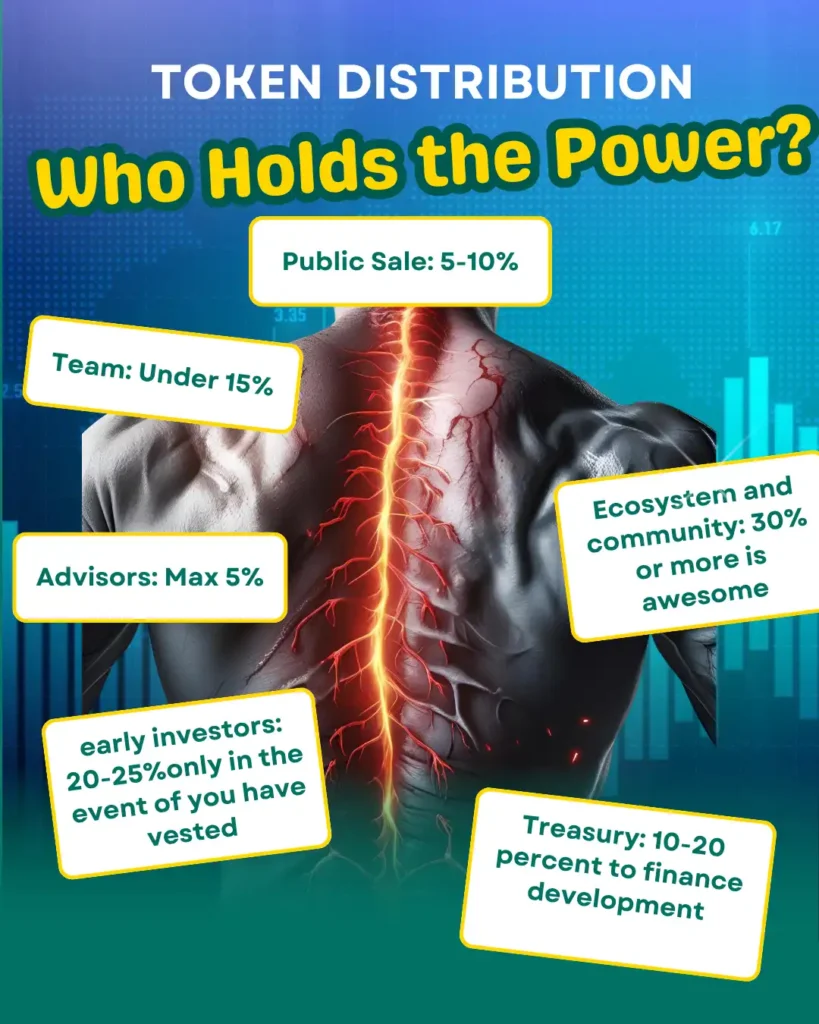
Distribution reveals where control lies. Concentrated ownership signals high volatility risk. A healthy structure distributes governance and liquidity across ecosystem participants.
Balanced allocation benchmarks:
- Team: ≤15%
- Advisors: ≤5%
- Early investors: 20–25% (vested)
- Public sale: 5–10%
- Ecosystem & community: ≥30%
- Treasury & development: 10–20%
Projects where venture funds hold over 40% under short vesting cycles often experience rapid sell-offs, undermining trust and long-term price performance.
How Do Vesting Schedules Protect Market Stability?
Vesting schedules prevent market dumps and align long-term incentives. They determine how and when tokens unlock after the Token Generation Event (TGE).
Preferred vesting structure:
- TGE Unlock: 10–20%
- Cliff: 3–6 months
- Linear Vesting: 12–36 months
This structure reduces volatility, rewards early believers, and maintains community trust. Smooth emission curves are key indicators of disciplined tokenomics.
Why Is Token Utility the Main Driver of Demand?

Token demand arises from its utility within the ecosystem. Tokens must have functional use, not just speculative appeal.
Common demand drivers include:
- Staking rewards paid in non-native assets (BTC, ETH, stablecoins)
- Real yield generated from protocol revenue
- Airdrops rewarding loyalty or governance participation
- Functional utility in gaming, gas fees, or governance
- Community strength that sustains belief and network effects
Tokens without utility or yield mechanisms quickly lose relevance. Sustainable projects design constant demand loops around usage and participation.
How Does Value Accrual Work in Tokenomics?
Value accrual measures how a token appreciates over time. Deflationary mechanisms outperform inflationary models by reducing circulating supply.
Effective value accrual strategies:
- Token burns: Reduce total supply through protocol fees
- Buybacks: Project purchases tokens to maintain scarcity
- Utility expansion: Introduces new use cases for token demand
- Staking-based incentives: Reward time commitment with higher yields
Projects like Celestia and Manta reward long-term holders with ecosystem airdrops, creating both scarcity and loyalty. This feedback loop enhances token value sustainably.
What Are the Core Principles of Sound Tokenomics?
| Principle | Description | Ideal Outcome |
|---|---|---|
| Supply Management | Capped or slowly inflating | Predictable scarcity |
| Emission Design | Gradual and transparent | Controlled liquidity |
| Fair Distribution | Balanced among stakeholders | Reduced manipulation risk |
| Utility Integration | Real and repeatable usage | Continuous demand |
| Value Accrual | Deflationary elements | Long-term appreciation |
| Transparency | Public unlock charts and audits | Investor trust |
Projects following these principles attract institutional confidence and foster organic community growth.
FAQs on Tokenomics
Q1. What’s the most critical element in tokenomics?
Supply distribution. Uneven control leads to price manipulation and short-term speculation.
Q2. Where can you track emission schedules?
Refer to the project whitepaper or tools like TokenUnlocks.com.
Q3. Are high APYs sustainable?
Only if backed by real yield. Inflationary APYs in native tokens often collapse value.
Q4. Should you avoid high FDV tokens?
Not always. But if circulating supply is under 10%, approach cautiously.
Why Understanding Tokenomics Creates an Investor Edge
Strong tokenomics transforms speculation into strategy. Every crypto crash or rug pull traces back to broken economic design. Evaluating supply mechanics, vesting, and demand cycles protects investors from hidden dilution and market traps.
Mastering tokenomics helps identify sustainable projects, participate in valuable ecosystems, and capture long-term opportunities in the next bull market.
What Makes Tokenomics the Real Game-Changer in
This is my own personal list for you:
- Supply that is reasonable, but ideally to be capped
- Emissions that are consistent over a long period of time
- Fair distribution (team/investor shares under control)
- Strong demand drivers (staking, utility, airdrops)
- Accrual of value (deflation buybacks, deflation, or burn)
- Whitepaper that is clear, translucent and unlock charts
Stay Connected with Us! For the latest updates, guides, and crypto insights, follow us on our socials:
Don’t miss out — join the Pro2Crypto community today!